Related Articles
Winter Moths
18th December 2025
Day-flying Moths
29th March 2026
Migrant Moths
29th April 2026
Moth Trapping for Beginners
31st May 2026
Festival of Change
29th June 2026
How does a moth hover?
29th June 2026
Moth Mornings
29th June 2026
Moth Trapping for Beginners: Tips
29th June 2026
Identifying Moths for Beginners
23rd July 2026
Revealing Romanian Moths
28th August 2026
Out-of area: North Wales
29th September 2026
The Black Witch
26th October 2026
Moth Migration 2026
Keen moth trapper Gert Corfield describes this exceptional year for migrant species.
What is less obvious (and a lot more diverse) is a similar phenomenon that has been occurring in the moth world. Moth-ers on social media are reporting astounding numbers of usually scarce or irregular migrant moths.
Undoubtedly, the record temperatures and consistently southerly winds have contributed to moths taking the conveyor belt from southern Europe and northern Africa to the UK. This is a strategy adopted by some moths to exploit new food sources and, if possible, procreate; however, most larvae do not survive our winters – at present, anyway!
With climate change, moths will have more success in overwintering as larvae. The White-point moth is a case in point (pardon the pun). Originally occurring as a rare migrant, there is now clear evidence that this species is breeding in the UK, first in southern and coastal regions but increasingly further north and certainly in our region.
So, which migrant moth species have been particularly noticeable so far this year?
Small Mottled Willow
Looking back at my own records, the first Small Mottled Willow (Spodoptera exigua) turned up in our garden in North Worcestershire in the first week of June. From then until the time of writing (mid-September), they have been present for almost every trapping session both in our garden and at two nearby farms where I trap. In the south of the country, moth-ers have reported trapping very large numbers. This moth is also known as the Beet Armyworm and, unfortunately, can be a major agricultural pest: the larvae feed on crops such as tomatoes, potatoes and – as the alternative name suggests – sugar beet. So, its presence is a double-edged sword: with a warming climate, will this once-rare species become a major pest? Only time will tell.
Humming-bird Hawk-moth
Also of note, and less controversial, is the astounding number of Humming-bird Hawk-moths (Macroglossum stellatarum). Seemingly wherever there are suitable plants (such as lavender, buddleia and honeysuckle), one or two are darting around using their long tongues to feed. A species that breeds in the Mediterranean, it may have been encouraged to migrate because its food plants were drying out in the relentless heatwaves there. I suspect no one would mind if these stunning creatures succeeded in breeding in the UK in future.
Vestal
For the more discerning moth-er, the appearance of Vestal (Rhodometra sacraria) has been a delight. A small creamy-lemon moth when in flight or disturbed during the day, it's nothing much to look at until it settles and reveals a fabulous pink candy-coloured stripe on its wings. Indeed, the whole moth may be more pink than white as it can be quite variable. Given their delicate appearance, it's a wonder they make it here at all. A benign species, it has made it onto many recorders' lists this year.
 Vestal (cream variant)
 Vestal (pink variant)
Notable micros
Other notable moths have been two micro species of ‘Pearls’ of the Crambidae family: Udea ferrugalis (Rusty-dot Pearl) and Palpita vitrealis (Olive-tree Pearl) – the latter common name reveals the breeding location and food plant! We recorded our first Olive-tree Pearl (much the scarcer of the two) at Kings Norton Nature Reserve in south Birmingham at the end of July this year and most recorders have added this species to their list this year. It looks delicate, with almost translucent wings, and most often appears in coastal locations in the UK, so seeing so many records in the Midlands and further north this year has been exciting.
Another migrant micro that has been present in higher numbers is Nomophila noctuella (Rush Veneer). Its larvae feed on clover and grasses, so you're as likely to disturb a few walking through a meadow as you are to catch them in your moth trap.
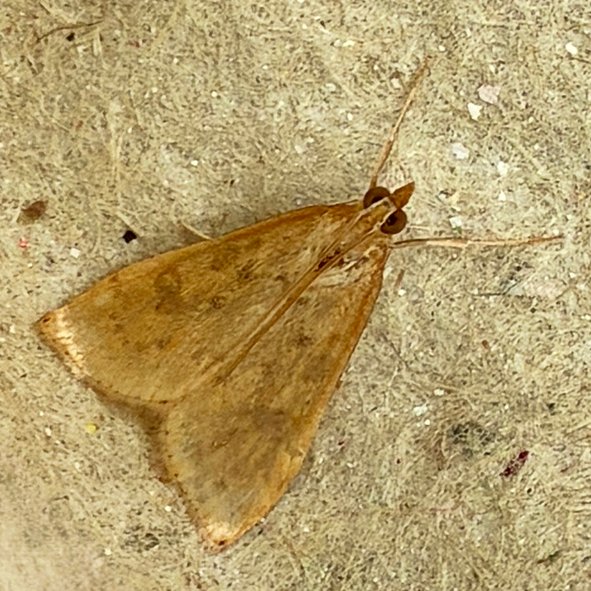 Rusty-dot Pearl
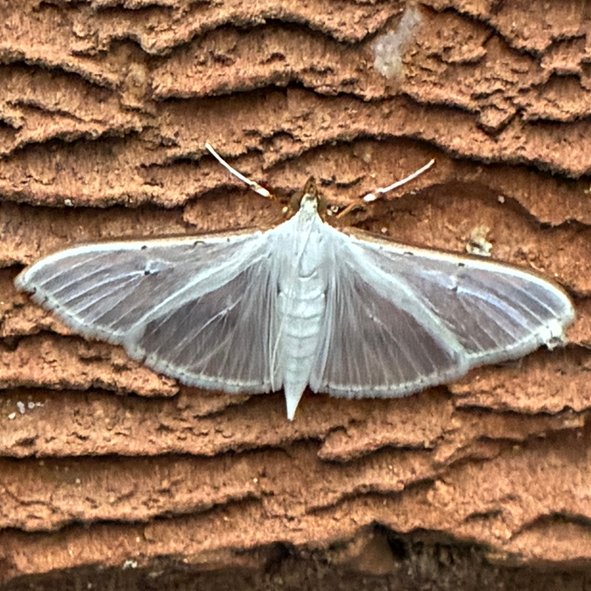 Olive-tree Pearl
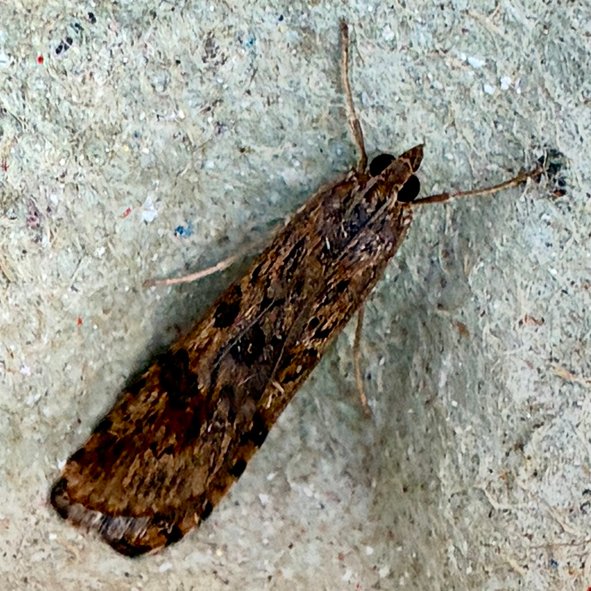 Rush Veneer
Ni Moth
A particularly exciting migrant that settled in our garden trap in early September was a Ni Moth (Trichoplusia ni). This is another of those whimsical names invented by early naturalists that gives the moth a certain charm, Ni (pronounced nee) being the name given to the broken white ‘Y’ marking on the forewing that supposedly resembles the Greek letter nu (v).
There have been very few records of this southern European / North African species in the West Midlands in the recent past; indeed, the UKMoths website states that in most years no more than around 50 individuals are recorded in the UK. Not this year it seems, with many more records in the West Midlands.
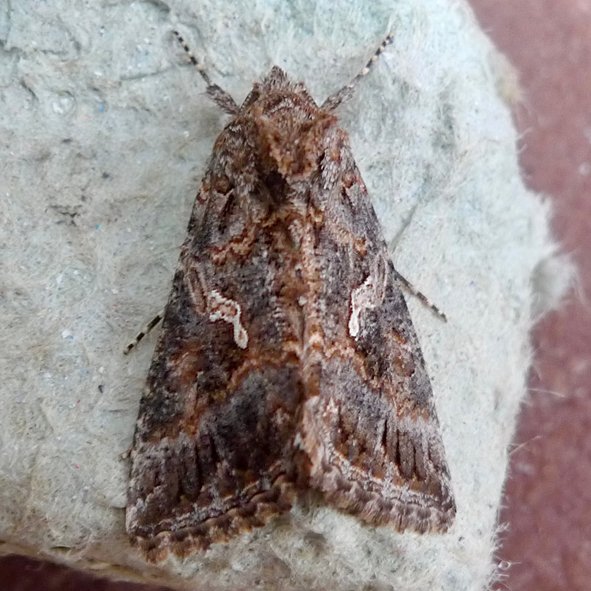 Ni Moth
.jpg) Striped Hawk-moth (Mike Wakeman)
Other Hawk-moths
If you were very lucky, you may have had a visit from a Striped Hawk-moth (Hyles livornica). Video clips on social media of these stunning creatures feeding on buddleia growing in the street have been somewhat surreal. Again, it's a scarce migrant that has made it to the Midlands in relatively good numbers this year.
Talking of Hawk-moths, two spectacular but quite rare migrant species would be the dream of many Lepidopterists: Death’s-head Hawk-moth (Acherontia atropos) and Oleander Hawk-moth (Daphnis nerii). With wing spans of up to 120mm and 130mm respectively and spectacular colouring to match, these monsters would be very welcome in any moth-er's garden!
Who knows, with warmer summers in future, these may become more frequent yet.