Related Articles
The rise and rise of the Brown Hairstreak butterfly
18th December 2025
My Volunteering Story - Jenny Joy
31st January 2026
My Volunteering Story - George Davis
18th December 2025
My Volunteering Story - Marian Newell
27th February 2026
My Volunteering Story - Mike Williams
29th March 2026
My Volunteering Story - Trevor Bucknall
29th April 2026
The Amazing Brown Hairstreak Egg Searching Season 2025–26
29th April 2026
My Volunteering Story - David Shearan
31st May 2026
My Volunteering Story - Gary Booth
26th October 2026
A Walk around Trench Wood
26th October 2026
My Volunteering Story – Simon Primrose
The Brown Hairstreak Species Champion for the West Midlands explains how he came into egg-searching.
However, my butterfly observations were restricted to species I saw in the garden, on Sunday afternoon walks beside the Grand Union Canal, and on family holidays to Devon or Cornwall. This resulted in me reaching my late twenties and realising that I’d seen less than half the species on the British list – not very good for the 'butterfly expert', as family and friends used to refer to me. Something had to be done! So, after lots of research, letters of enquiry and permit applications, I set about seeing the remainder, a feat I largely – but not completely – accomplished over the next three summers. (I still have Cryptic Wood White to see, although that wasn’t even recognised in the late 1980s).
Egg-searching
My volunteering story, though, didn’t really begin until I retired from full-time work, just over 16 years ago. I’d always thought that looking for Brown Hairstreak eggs during the winter would not only be very rewarding but would also keep the butterfly interest going through those long, cold, dark months. So, within a few weeks of finishing work, I turned up to my first egg hunt, near White Ladies Aston I seem to remember, and met Mike Williams and the rest of the egg-searching gang. I was instantly hooked and volunteered to take on lots more searching, which I did and became fairly successful at.
The reason egg-searching is so important for a species like Brown Hairstreak is that the adults are so elusive and it's very difficult to assess their numbers using the traditional transect method favoured for other species. Egg-searching is much more productive and gives an accurate picture of their numbers and the health of their population.
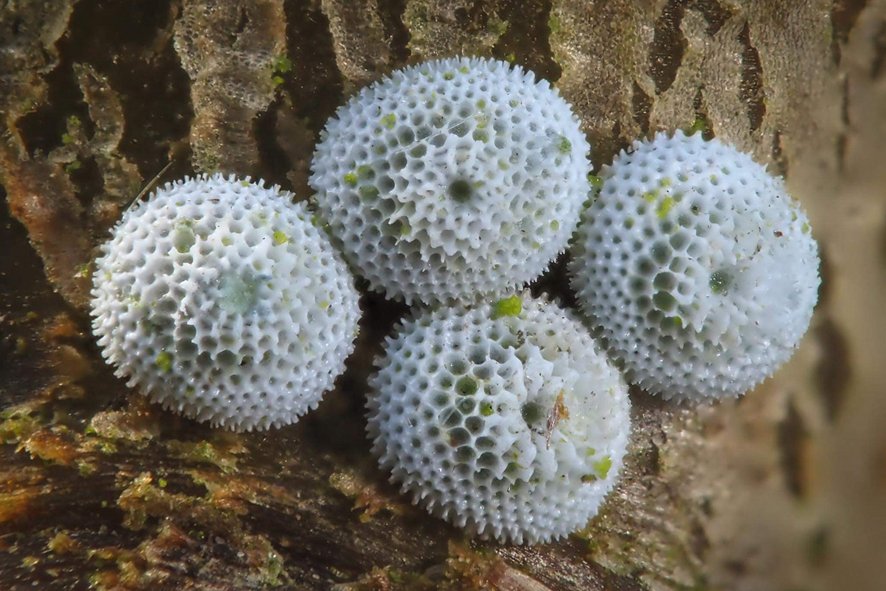 Rare quadruple egg cluster
Championing a species
A few years later Mike, who was Brown Hairstreak Species Champion at the time, offered me the chance to take over the role. Although somewhat daunted by the responsibility, I gladly accepted. It’s been extremely satisfying to witness the incredible range-expansion of this species over recent years, from 160 known 1km grid squares when I joined the team to the 402 squares we know about now, sixteen years later!
I still hold the role today and, over the last three years, I’ve expanded our search repertoire to incorporate the relatively new science of monitoring larvae, at night in the summer, using UV torches. This very exciting activity is possibly even more accurate in determining population levels than looking for eggs in the winter, albeit involving many late nights as it's not dark enough to start until about 10pm.
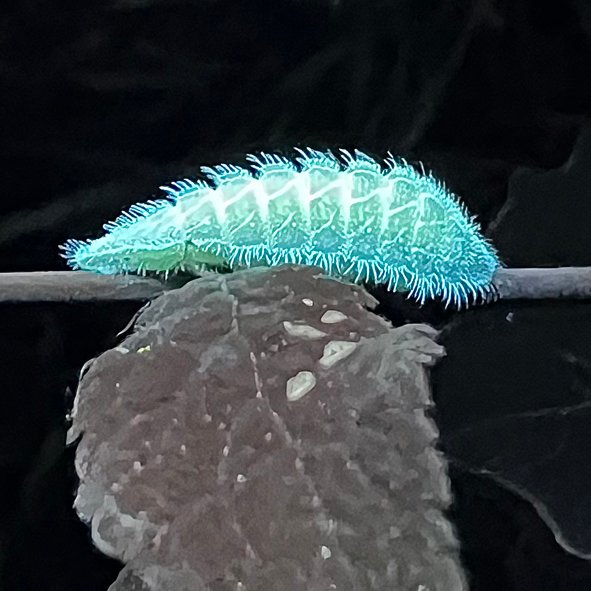 Brown Hairstreak larva under ultraviolet light
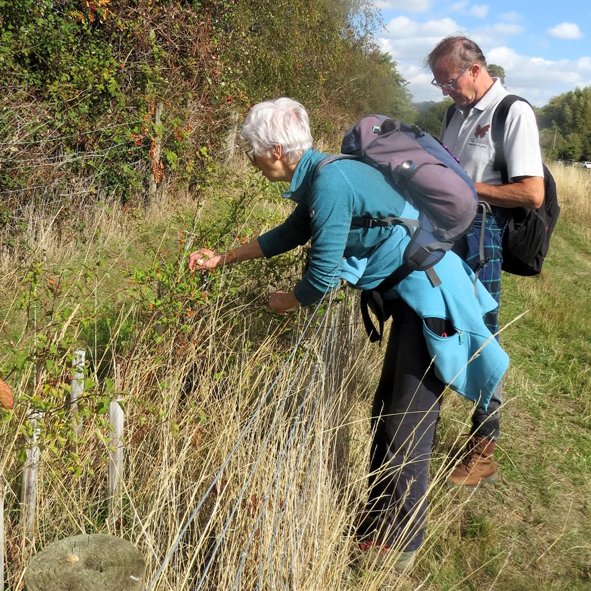 Searching with the 'Streakers'
The wider picture
These days, I also get involved with other species at a detailed level. This mainly entails habitat assessments and fieldwork monitoring of both adult butterflies and their earlier life cycle stages, and the subsequent recording and mapping of their distributions. I’m especially interested in the recent arrivals to our region, such as Small Blue and Purple Emperor.
I look forward to many more volunteering adventures in future years…