Related Articles
My Volunteering Story - Jenny Joy
31st January 2026
My Volunteering Story - George Davis
18th December 2025
My Volunteering Story - Marian Newell
27th February 2026
My Volunteering Story - Trevor Bucknall
29th April 2026
My Volunteering Story - David Shearan
31st May 2026
My Volunteering Story – Simon Primrose
29th September 2026
My Volunteering Story - Gary Booth
27th October 2026
My Volunteering Story - Mike Williams
Many of us know Mike in one context or another but perhaps few of us realise just how much he's been involved with
Work history
Like many people, I left school with no career plan. I did an economics degree at Kingston Poly but still had no idea what I wanted to do. I secured a job as a Research Assistant with a firm of London Stockbrokers but soon realised this was not for me and gave up the job after a year to return to Swindon, my home town.
There I became involved in local politics and took part in campaigns against various development and road-building proposals that would have destroyed people’s homes. This suited me far better and, when Idi Amin decided to expel all Ugandan Asians, I volunteered at the Community Relations Council to help refugees move into homes offered by the local Council and build new lives for themselves and their families. Looking back, it was a big contrast to today's attitudes: people wanted to help and were overwhelmingly welcoming, caring and compassionate towards the refugee families.
After failing to be elected to the local Council by just 28 votes and newly married, I applied to do a post-graduate diploma in community work at the University of York. It was an enjoyable year and afterwards I obtained a job in inner-city Coventry as a Community Worker. We found a house on the outskirts of the city and it was while there that I became more interested in wildlife, initially in birds but later in other things as well.
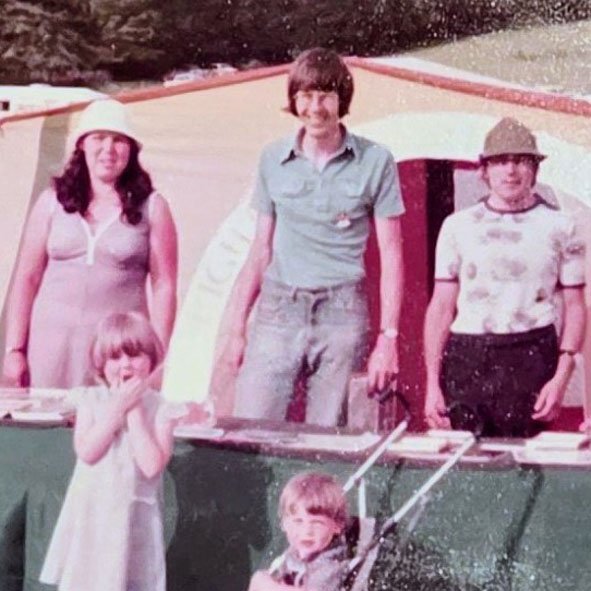 Hagley Hall in 1982 with the late Terry Green (co-founder of the West Midlands branch), Terry's wife and my children
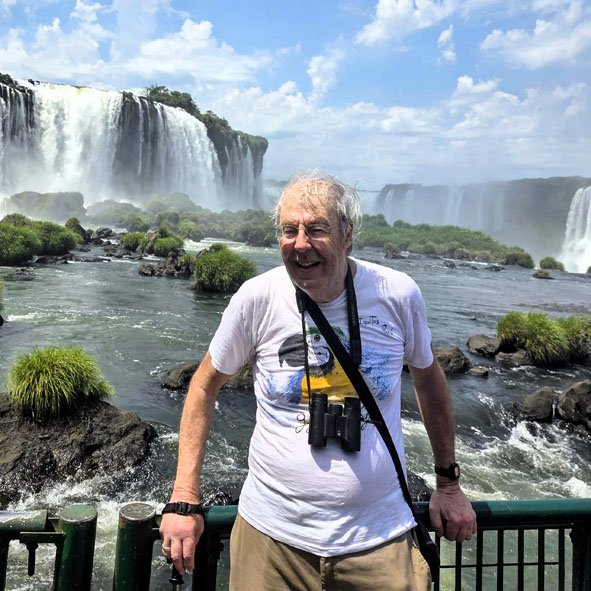 Iguazu Falls, Brazil, in 2026 on the latest of many trips to see butterflies, moths and other wildlife
Conservation roles
I often say that my inability to recognise bird song once there were leaves on the trees led me to look for things that I had a chance of identifying. This is true to an extent but the real eureka moment with butterflies came later. I belonged to what later became the Warwickshire Wildlife Trust and began to attend some events, one of which was a field trip to a reserve called Oxhouse Farm led by the county butterfly recorder. The reserve is an old railway line and the glorious weather brought butterflies, especially Marbled Whites, out in their hundreds. I was hooked!
.jpg) Marbled White - the species that started my volunteering journey (Peter Smith)
Marbled White - the species that started my volunteering journey (Peter Smith)
I contacted the national charity for butterflies and moths, the British Butterfly Conservation Society (later Butterfly Conservation). It was very small but, by chance, the officer responsible for running displays and sales lived in Coventry. We decided to set up a West Midlands group, organising a programme of field trips and producing a two-page newsletter inviting people to join us. We had a good response and elected a small committee and became the first local branch. Other regions followed and soon there was a network of branches. At this point, the charity had no paid staff, owned no reserves and had little by way of structure. Some of the more active branches formed a National Development Committee to address these issues and set up sub-committees for Conservation, Education & Information and Publicity & Fundraising. Many West Midlands branch members served on the sub-committees and helped develop the modern charity.
I served on the Conservation Committee for some years, eventually becoming its Chair, and during this period we acquired Monkwood in Worcestershire jointly with the Wildlife Trust, followed by Trench Wood and Grafton Wood. This was the start of a fruitful partnership that has continued to the present day. In 2002, I was honoured to be presented with the Worcestershire Wildlife Medal for services to conservation.
As time went on, I was able to use some of the skills I learned as a Community Worker to further, along with others, the work of Butterfly Conservation locally. I held various voluntary roles in the branch: Newsletter Editor, Branch Organiser, Conservation Officer and Publicity Officer – ultimately serving on the committee for 45 years. We developed good relationships with other conservation organisations across the region and began to raise money to pay for research projects to help conserve butterflies locally. I got to know many people as a result of this, many of whom have gone on to become good friends. We also began to undertake practical conservation work on sites of importance to butterflies and moths.
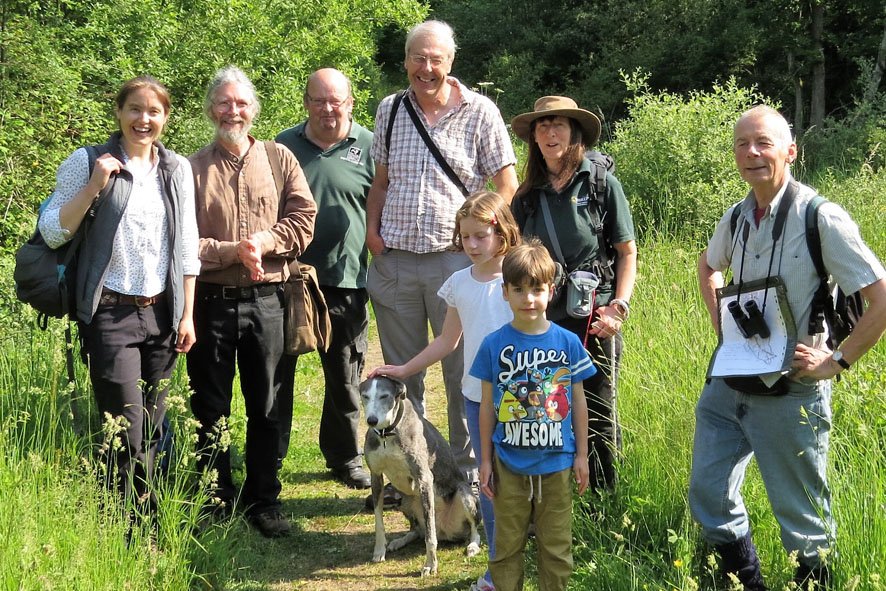 Wood White release in 2016
In 1980, now with a young family, I moved across to Worcestershire. I chose to live near the Wyre Forest, where I started the first butterfly transect which I walked for the next 17.5 years before a job move to inner-city Birmingham made it impractical.
Although my volunteering story is focused on the West Midlands, it veered off course from time to time. During my time as Chair of the Conservation Committee, we raised funds to employ Butterfly Conservation’s first Conservation Officer and I chaired the panel that appointed Martin Warren to the role – a fact I reminded him of on occasions! To celebrate the 21st anniversary of West Midlands branch in 2000, I ran a one-off butterfly holiday to the Pyrenees; it proved so enjoyable that I've been organising foreign trips ever since, most recently to Brazil. A trip to Hungary in 2006 led to the formation of the European Butterflies Group, which now offers volunteer opportunities to help with butterfly surveys in various European countries.
Other achievements of the West Midlands branch include the long campaign that led to the acquisition of Prees Heath as a reserve, the publication of books on regional butterflies and moths, and the development of a partnership with Forestry England, Natural England and Twycross Zoo that we hope will lead to the successful reintroduction of the Kentish Glory moth to the Wyre Forest.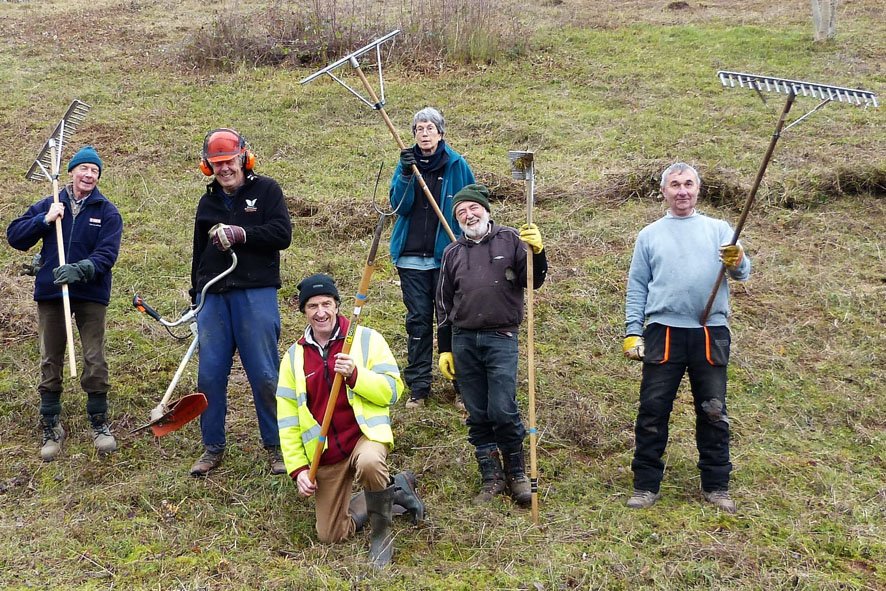 Ankerdine Hill workparty in 2022
West Midlands Butterfly and Moth Society
To bring my story up to date, I and several other long-standing members chose to stand down from the West Midlands branch committee last Autumn to form a new group. This was prompted by changes in the way that Butterfly Conservation operates, which we felt were detrimental to our conservation work locally. Our aim is to build on the successes achieved over the years but operating independently enables us to set our own policies, raise our own funds and work effectively for the conservation of butterflies and moths.