Related Articles
UK Butterfly Recorders' Meeting 2026
29th April 2026
More than a Feeling
16th October 2026
Putting Telford's Butterflies and Day-Flying Moths on the Map
27th October 2026
The Butterfly Situation in Eccleshall, Staffordshire
Thomas Knowles reviews the butterflies he has seen this year around Eccleshall, a few miles north-west of Stafford. The photographs were kindly supplied by Andrew Fusek Peters.
Having moved here from the North Cotswolds, I was at first struck by how few butterflies were around. Some species such as Marbled White, which were prolific in Gloucestershire, have never been identified for certain locally, although I understand that they have been recorded elsewhere in Staffordshire and I was told of a possible dead one found in an Eccleshall driveway in July 2018.
2026 has been a very good year for some species but what has been noticeable is that the emergence of some varieties has been earlier than usual and likewise they have disappeared early. This is no doubt a result of the long dry Spring and Summer that we have enjoyed.
Broadly speaking, we can count on seeing 18 species each year supplemented by less regular sightings of a few less usual butterflies that appear from time to time.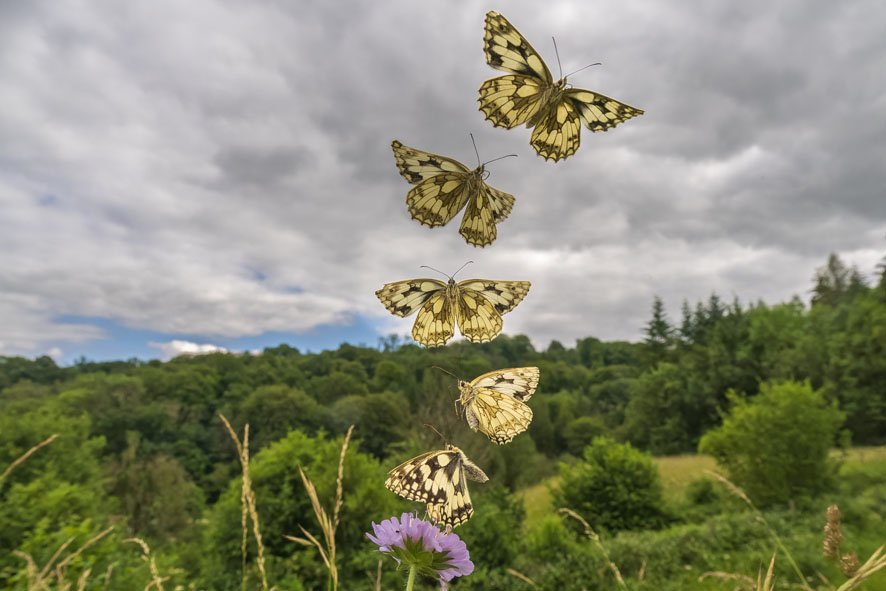 Marbled White in flight
Early emergers
Over the years the Small Tortoiseshell has often been the first butterfly to be seen, although more recently the Comma has been noticed earlier. The Small Tortoiseshell has been very inconsistent, peaking in 2019–21 but then tailing off quite dramatically. In recent years, the Comma has improved a little despite its numbers being rather low. So far, this year has been disappointing but, as I write this in late September, there's still time for an autumn brood to be seen. In recent hot summers, Small Tortoiseshells have located themselves in the tower of Holy Trinity Church in a state of aestivation during the hot weather and some also hibernate there. However, the earliest sighting has been of a Red Admiral on 1 February 2022. Sightings of this butterfly have improved over the years and 2026's peak day on 13 July, when 56 were noted, was the best day since I have lived in Eccleshall. Most years, Red Admiral is the last butterfly on the wing locally, largely to be found on ivy.
Another early butterfly that has hibernated is the Peacock. 2026 had a golden spell for this butterfly in mid-July and the numbers seen were only exceeded in 2019. Another butterfly that hibernates is the Brimstone and, although in the area that I cover it is only ever seen in penny numbers, they are certainly around in the greater Eccleshall area from what people tell me. I guess that there is a shortage of caterpillar fodder (buckthorn) in the immediate area of the Town.
Normally three coloured species appear in Eccleshall during April: Orange-tip, Holly Blue and Speckled Wood. This year Orange-tips were about average, Speckled Woods got off to a slow Spring but have been OK in the late Summer and early Autumn; year on year one can predict where they will be found and I would describe them as very parochial but Holly Blue has been exceptional this year and unusually on the wing throughout most of the Summer with the second brood to be seen from the start of July. The best day in 2026 saw nearly three times more recorded than in 2021, the previous best day over the last 20 years.
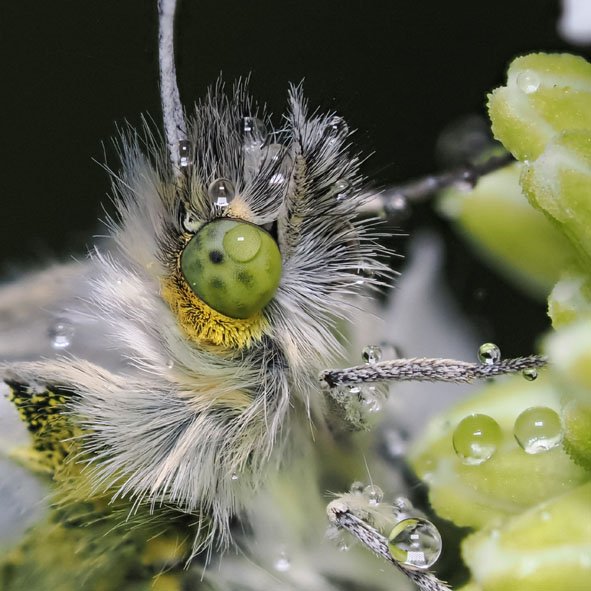 Orange-tip
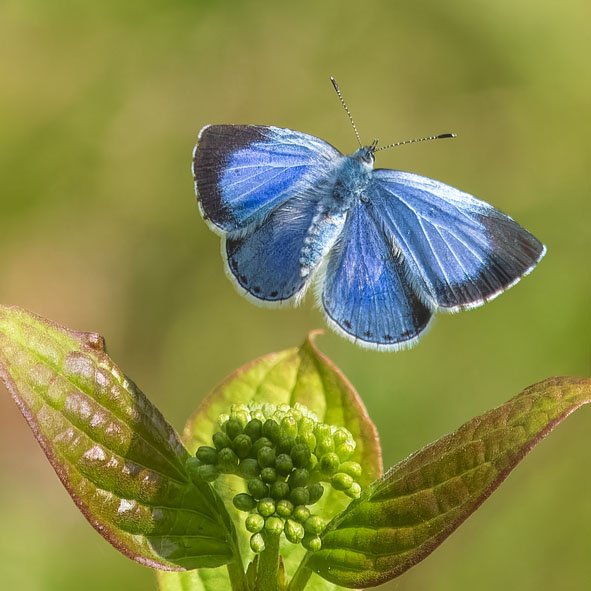 Holly Blue
Of course, the white butterflies begin to be seen in most Aprils as well. Normally there is a break between broods from late June to early July, but this year the break in sightings was wholly in June. Small Whites had a fairly average year, while Green-veined Whites had their worst year since we've lived here. I must say that in my recordings I do keep a column of unidentified whites since in the Spring it is sometimes difficult to be sure whether one has seen a Small or Green-veined White or, indeed, a female Orange-tip. As Summer gets underway, I abandon this column because there are too many to try and identify, so I realise that these species are understated. Large Whites did not have a good year. The Spring figures suggest that their efforts to over-winter in chrysalis form failed badly therefore, the majority of Large Whites seen had arrived from Europe. They were on the wing in relatively consistent numbers from the beginning of July but overall it was the worst showing since 2019, which was disappointing when 2025 had been so exceptionally good.
Large Whites are not the only immigrant butterflies that we see; the Red Admiral also has an abundant supply of adults from the Continent. Painted Lady is another butterfly that has worked its way up from North Africa. With wind currents varying each year, the presence of this butterfly is very hit and miss. The media have declared this year as the year of the Painted Lady and indeed it has been a very good year with an early sighting on 1 May. However, greater numbers were observed in 2009 and especially 2019. To put into context, however, there were three years when none at all were recorded locally. The other immigrant butterfly to mention is the Clouded Yellow. Although common enough in Southern England, until this year the only time I had seen one in Eccleshall was on 24 October 2006. 20 years on and there have been several sightings this year, including a very close up and exciting encounter in our garden on 11 September.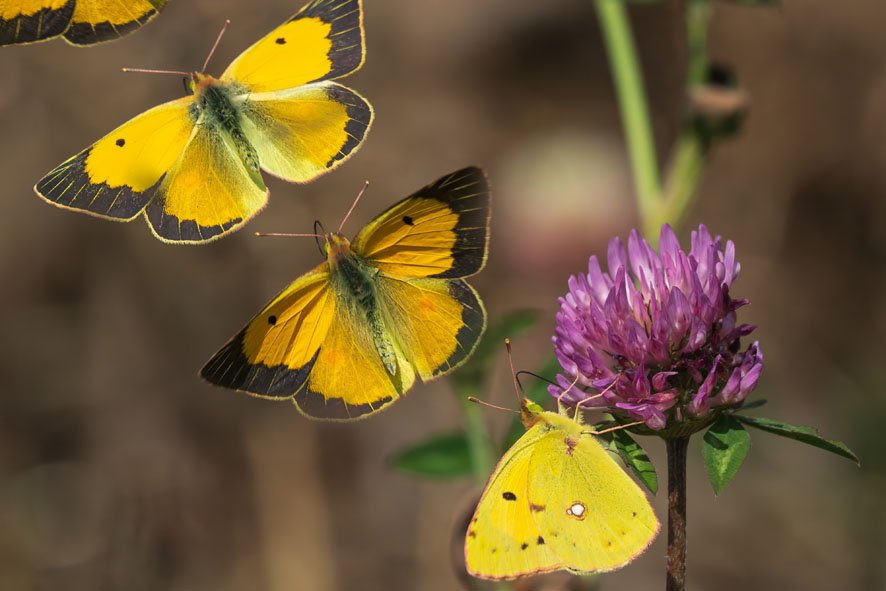 Clouded Yellow
Field butterflies
As summer approaches, what I call the field butterflies are to be seen on the wing. Usually, Meadow Brown is the first to appear. The field butterflies suffered from about 2016 with the building of the Sancerre housing development which lost a significant area of habitat. The developers, Bovis, have created a wild area around a retaining pool and generally sightings have recovered. Meadow Brown had a very good year in 2026 and Small Skipper, which appears at much the same time, had its best year since we've lived here.
When we moved here, I was told by the Staffordshire butterfly recorder that Ringlet butterflies had not been reported in Eccleshall. Small numbers were recorded from 2006 peaking in 2015. Then the building works took place and this species has never fully recovered. However, this year was its best showing since the building work started.
The other field butterfly, Gatekeeper, emerges later than those already mentioned. In 2026 after some dreadful years since the building, there was a remarkable recovery: sightings exceeded the previous best year, 2006, on three separate days. The flight period was interesting in that it both started and finished three weeks earlier than usual.
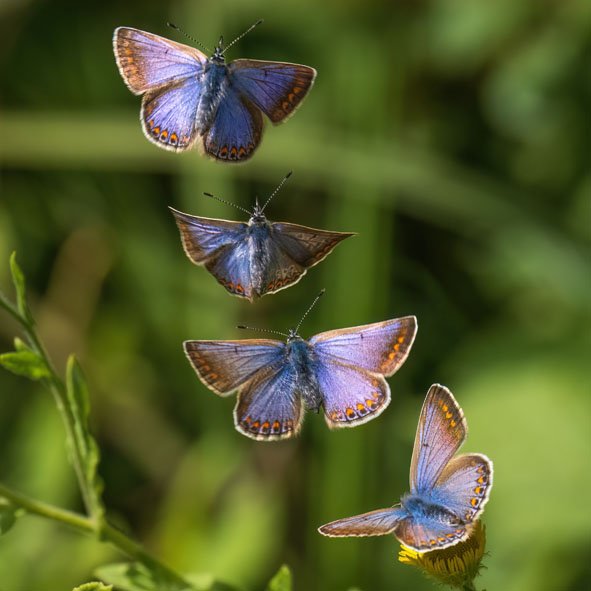 Common Blue
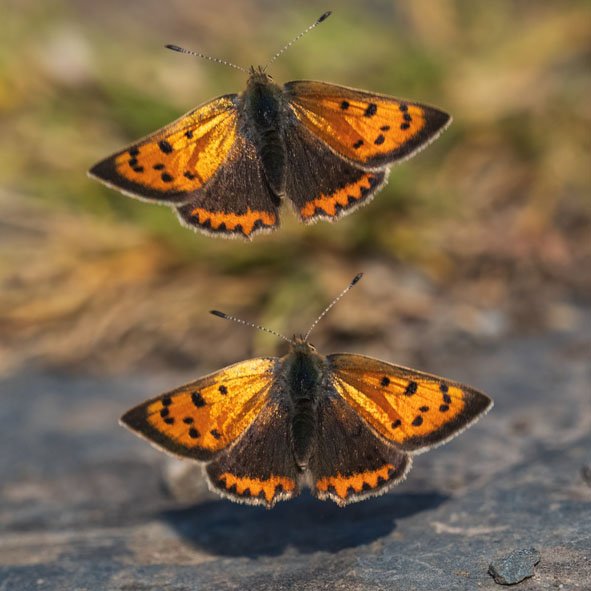 Small Copper
Other species
So, what other butterflies are observed in Eccleshall? Every year apart from 2014 and the bad year of 2024 I have recorded the odd Common Blue. This year became the best seen since we moved here, with 19 noted on one day when the previous best day recorded just eight. People in the street were accosting me and commenting on the number of small blue butterflies they had seen – clearly both Common and Holly Blues.
The similar sized Small Copper is supposed to emerge in a warm Spring but most of my observations in Eccleshall have been of the second brood, with October sightings in some years. However, numbers are rather small and in 2024 none were recorded all year. Brown Argus has been seen in about half the years that we have lived here and never more than two records on the same day in a year. In July 2018 a Small Pearl-bordered Fritillary was seen and photographed in a garden adjacent to Holy Trinity Church. A fortnight later, a dead butterfly was reported in a driveway that sounded like a Marbled White (I didn't see it); the 2016 book Butterflies of the West Midlands indicates this species has been seen in a few locations in Staffordshire and the nearest to Eccleshall looks to be on the southern outskirts of Stafford.
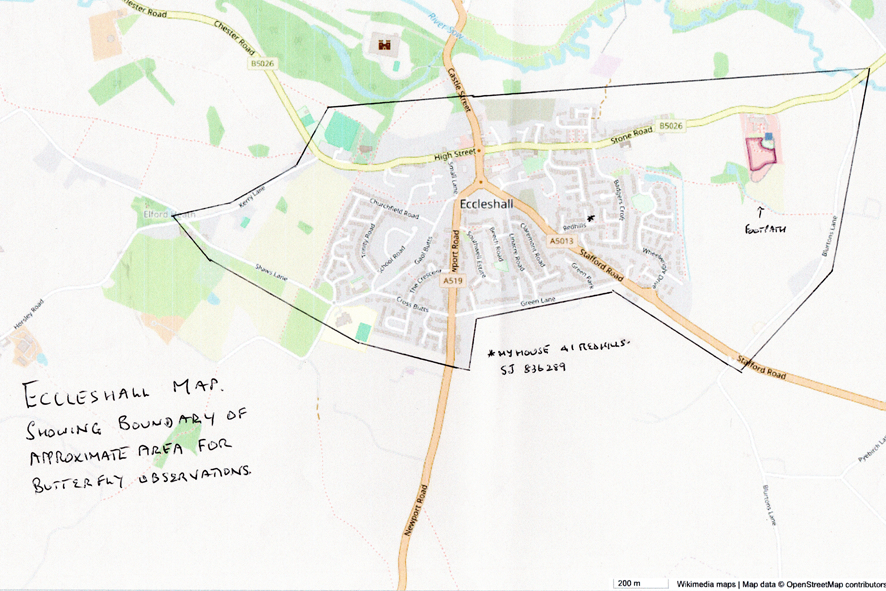 Map of Eccleshall showing the area within which these observations are made
Closing thoughts
I thought readers might like some miscellaneous comments about butterflies in Eccleshall, most of which are based on my own observations:
- Earliest butterfly: a Red Admiral was seen on 1 February 2022, basking in winter sunshine on a house wall in a garden in Redhills, Eccleshall. I saw another two days later in Holy Trinity Churchyard, among the snowdrops.
- Latest butterfly: a Red Admiral was seen on the wing on 22 December 2011 in Fox Hollow, both by me and by a resident of that road. Apart from that, the last sighting of a butterfly in Eccleshall normally takes place in November or very late October.
- Highest number of butterflies in a day: this varies in number and date, as shown by the numbers for recent years:
2020 – 254 on 20 August
2021 – 326 on 23 August
2022 – 205 on 1 August
2023 – 369 on 26 July (then the highest since we lived in Eccleshall)
2024 – 83 on 11 August (a dreadful year, not just in Eccleshall)
2025 – 358 on 12 July
2026 – 406 on 13 July (the best ever, as far as I am concerned)
From this you will note that the best day varies by six weeks and in 2017 the best day was even later. The less said about 2024 the better!
Finally, I should explain how I make most of my observations. I don't undertake the same walks daily but try to visit known locations where butterflies are likely to be seen – these vary with the seasons. I feel that I know every accessible mature buddleia in Eccleshall because from mid-summer onwards these attract plenty of butterflies. Likewise, at the end of the season, ivy attracts the final butterflies of the year. Throughout the year there are specific locations where Speckled Woods are to be seen and in high summer the fields attract what I have described above as field butterflies. Weather is also a consideration: I avoid exposed locations as far as possible when it is windy. Also, if I return by a path that I have already covered, I'm careful not to double-count butterflies already noted.
Eccleshall is a pleasant place to walk around, even though it is perhaps not the most prolific in terms of butterflies.